
Pelicans on Bicycles: How GPT-6 Astra Stacks Up Against GPT-5.6
Translated by a model; the original is in Russian.
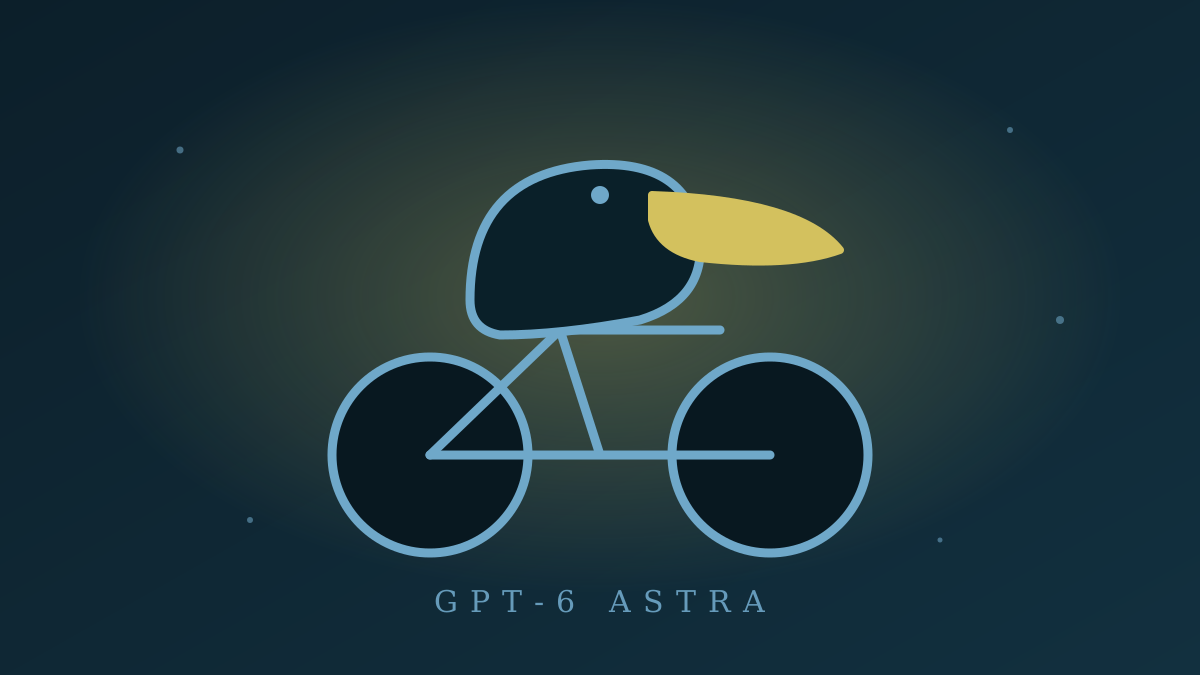
Simon Willison, known for his unconventional way of evaluating language models, got access to GPT-6 Astra and immediately applied his usual trick. He asked the model to generate an SVG image of a pelican riding a bicycle — and did so at every available “reasoning” level: low, medium, high, xhigh and max (Astra has no none mode).
The author compiled the resulting images into a single comparison table alongside the results of the previous generation of models — GPT-5.6 Sol, Terra and Luna. In his words, the exercise turned out to be not merely entertainment but a genuinely substantive experiment.
Astra draws noticeably better
The main takeaway: Astra's pelicans are palpably superior to the competition. The best variant from GPT-5.6 Sol (the author preferred xhigh over max) still looks like a set of abstract shapes, whereas any Astra pelican — even at the minimum level — comes across as more convincing. Willison calls the result at the max level genuinely good. That said, below the maximum the model still doesn't always draw the pelican's legs on both sides of the frame.
Pricier, but more economical
Astra is roughly twice as expensive as Sol: 10 dollars per million input tokens and 50 per million output tokens, against 5 and 30 for Sol. However, the new model spends noticeably fewer tokens at each level, so the resulting price difference turns out not to be so dramatic. By the author's calculations, Astra at the low level produces a better pelican than any of the GPT-5.6 Sol models at any level — and for just 9.55 cents. Spending the same ten cents on another model means getting a far more modest result.
A curious detail
Willison separately draws attention to the number of input tokens for an identical prompt: Astra and Luna both used 16, while Sol and Terra used 26. From this he builds a cautious hypothesis: perhaps Astra and Luna are more closely related than OpenAI lets on.
Source: Simon Willison
Comments
Sign in, to comment.